BLOGGER TEMPLATES AND TWITTER BACKGROUNDS

Wednesday, February 10, 2010

2010 Olympic Hockey: My Flawless Predictions

We are nearing close to the 2010 Winter Olympic Games in Vancouver. For the one moment every 4 years, we get reintroduced to so many sports and competitions that make the Winter Olympics; everyone loves their skiing, curling, and figure skating drama.

But if you're like me, the sport I plan on watching the closest is hockey. Since hockey, as well as the NHL, is such an international sport, many fans are torn between cheering on their home country and hoping for the best for the foreign players on their team of choice. With so many countries sending out top-notch talent to the Olympics, how on Earth can anyone predict which three national teams will be on the medal podium, and in which order? Luckily for you, I set out on a foolproof way of figuring this out.

So what is the most scientific, non-biased way of predicting the outcome for the Olympic hockey tournament? Not highly researched and analyzed simulations...but video games. It probably would have been great to have the most recent game with which to play this out, but EA Sports discontinued their NHL franchise for PC, and NHL 2k10 did not come out for PC either. Thus, all of the games were played out on NHL 09 for PC. Thankfully, ESPN.com had pretty much all NHL 10 player ratings on their website for NHL 10, so I adjusted ratings accordingly for the players in the Olympics. Because I started my virtual Olympic hockey tournament before any countries announced roster changes, I used each country's initially announced 23-man roster, which all came out around New Year's Day. I used 5 minute periods because they best reflect the amount of shots that will probably be taken in games, and overtimes were decided by a five-minute overtime followed by a shootout as they will in the Olympics. The rules were adjusted to the international rules that will be in effect in Vancouver (e.g., no-touch icing). Because no neutral ice feature exists on NHL 09, the home team for each match was the first team listed in its matchup on the Wikipedia link below; the better teams (in IIHF ranking) in the group got 2 home games in the preliminary round, the worse ones got 1, and the better seed got home ice in the knockout round. Finally, for reality's sake, each game was played out in its announced order. Without further ado, for your entertainment, here's how it played out on my computer...

(Note: In the Preliminary Round, regulation wins count for 3 points, overtime wins count for 2 points, overtime losses count for 1 point, and no points for regulation losses)
PRELIMINARY ROUND
GROUP A

Team W OTW OTL L GF GA GD PTS
Canada 2 0 1 0 17 11 6 7
United States 2 0 0 1 10 7 3 6
Switzerland 1 1 0 1 12 12 0 5
Norway 0 0 0 3 7 16 -9 0

GROUP B
Team W OTW OTL L GF GA GD PTS
Russia 2 1 0 0 8 4 4 8
Czech Republic 2 0 1 0 8 4 4 7
Latvia 1 0 0 2 6 6 0 3
Slovakia 0 0 0 3 0 8 -8 0

GROUP C
Team W OTW OTL L GF GA
GD PTS
Sweden 3 0 0 0 12 6 6 9
Finland 1 1 0 1 8 8 0 5
Germany 0 1 0 2 6 8 -2 2
Belarus 0 0 2 1 5 9 -4 2

Teams are ranked 1 through 12 based on group rank, points, and goal differential; teams ranked 1 through 4 (#1 Sweden, #2 Russia, #3 Canada, #4 Czech Republic) had a bye into the Quarterfinals, while 5 through 12 play a secondary round to reach the Quarterfinals...
SECONDARY ROUND
#5 United States vs. #12 Norway (winner plays Czech Republic): United States 3, Norway 0
#6 Finland vs. #11 Slovakia (winner plays Canada): Finland 6, Slovakia 3
#7 Switzerland vs. #10 Belarus (winner plays Russia): Switzerland 4, Belarus 1
#8 Latvia vs. #9 Germany (winner plays Sweden): Latvia 4, Germany 1

The winners and terms in parentheses showed the Quarterfinal matches. Because of the time rules, most likely for TV viewers' convenience, the United States played the first game, while Canada played the second...
QUARTERFINALS
#4 Czech Republic vs. #5 United States (winner plays Sweden-Latvia winner): Czech Republic 3, United States 1 (darn it)
#3 Canada vs. #6 Finland (winner plays Russia-Switzerland winner): Finland 3, Canada 2 (SHOCKER!!)
#1 Sweden vs. #8 Latvia: Sweden 1, Latvia 0
#2 Russia vs. #7 Switzerland: Russia 4, Switzerland 1

I found it a bummer that both North American teams got knocked out before the semis, but the show must go on. The winner of these games play for the gold medal, while the losers play for the bronze...
SEMIFINALS
#1 Sweden vs. #4 Czech Republic: Czech Republic 6, Sweden 3
#2 Russia vs. #6 Finland: Russia 7, Finland 4

Goals galore. Looks like Sweden isn't repeating this Olympics. So now we've reached the big moment: which three countries are going home with the players wearing medals around their necks?...
BRONZE MEDAL GAME
#1 Sweden vs. #6 Finland: Sweden 3, Finland 1
GOLD MEDAL GAME
#2 Russia vs. #4 Czech Republic: Russia 6, Czech Republic 1

Unfortunately, this was a very non-climactic ending, as you can see from the score. Russia as gold medalist, should they win it in real life, should come as a surprise to nobody as the team is filled with major NHL stars, along with some KHL stars (some of which are former NHL stars).
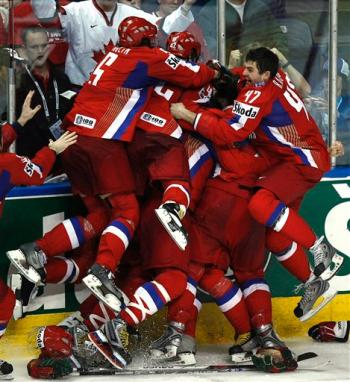
Your final standings, 12 to gold: (teams 9 to 12 are losers in the secondary round ranked based on preliminary round rankings, 5 to 8 lost in the quarterfinals and are also ranked based on preliminary round rankings)
12. Norway
11. Slovakia
10. Belarus
9. Germany
8. Latvia
7. Switzerland
6. United States
5. Canada
4. Finland
BRONZE: Sweden (Top Scorer: Henrik Zetterberg)
SILVER:
Czech Republic (Top Scorer: David Krejci, Martin Havlat, and Milan Michalek tied)
GOLD: Russia (Top Scorer: Sergei Fedorov, over all their other stars)

Obviously, Teams U.S.A. and Canada were big disappointments by finishing short of the medal rounds. Also, Slovakia, pointed out by many to be a dark horse candidate for a medal, failed to even score a goal until the knockout round.

And there you go. Through my scientific process, I've showed you which country is bringing home the gold in men's hockey. Now you don't have to watch the games in suspense, although you might want to watch just to make sure I got it right. I hope you were entertained, and I hope you enjoy the entire 2010 Winter Olympics.
Thursday, February 4, 2010

The Top 10 Baseball Teams of the '00s

Wow, this was a long project. Nearing the end of the year 2009 and thus the decade, sports networks and websites started posting their "best of the decade" lists. Off the top of my head, I can remember NFL Network showing the top 10 plays of the decade, baseball writer Rob Neyer's (whose co-authored book plays a big part in this post) list of the decade's top 50 MLB players, and MLB.com analyzing which MLB team had the best decade. So, now I guess it's my turn.

In this post I hope to show you, through examining individual statistics, team statistics, and team accomplishments, which MLB teams had the best season in the decade. Because I am only looking at single seasons, franchises could potentially hold multiple spots on this list.

What, exactly, are my standards for ranking teams? My main standards are the following: Pythagorean Record, standard deviation (SD) score, postseason accomplishments, and regular season record. Pythagorean Record and SD score appear prominently in Rob Neyer and Eddie Epstein's Baseball Dynasties: The Greatest Teams of All Time, and are what I feel are excellent measures of a team's dominance during the season. Pythagorean Record projects a team's typical winning percentage based on their runs scored and runs allowed. SD score compares a team's runs scored and runs allowed with the rest of the league; the number of standard deviations above league average in both runs scored and runs allowed are added together to form the SD score. Thankfully, Baseball-Reference.com has already calculated Pythagorean Record, so I had to do only a little calculation on my own. However, no site I found has published SD scores, so I had to make all the calculations myself, based on Eddie Epstein's description of the formula in Baseball Dynasties.

The "tiebreaker" portion of my rankings that places teams I think are extremely close in the previously mentioned standards is to assess the "star power" on the teams; did they have any players having absolutely standout seasons? Certainly, this standard is subjective and could start debates, but it is a very minor part of the rankings compared to other factors. So, with these standards in mind, let's get to my rankings!

A brief note: As you probably remember from this past decade of baseball, the most dominant regular season teams were certainly not always the ones raising the Commissioner's Trophy at the end of the World Series. This definitely showed in the statistics. I was hard-pressed to give a good deal more credit to teams who won the World Series when, in reality, there were many teams who flamed out in the playoffs that were incredibly dominant during the regular season.

10. 2001 Arizona Diamondbacks 92-70, Won WS, #25 Pyth, #21 SD Score
I'll admit this right off the bat (haha, punny): I really had to work to get World Series champs on this list. The most dominant teams according to the statistical measures usually fell apart come playoff time, so I increasingly gave more weight to winning it all. With all those World Series the Yankees had won in the previous years, you know you were rooting for the D-Backs to win this series. Randy Johnson and Curt Schilling were one of the most dominant 1-2 starting combos of the decade, while Luis Gonzalez belted an amazing 57 HRs to lead an extremely experienced offense (none of their primary regulars were under the age of 30). On a personal note, 2 former Pirates, Jay Bell and Tony Womack, got their long-awaited rings, so it gave me an extra reason to hope they would succeed.

9. 2008 Philadelphia Phillies 92-70, Won WS, #32 Pyth, #18 SD Score
I had the pleasure of being at Citizens Bank Park to watch them clinch their division in thrilling fashion; I've never heard a baseball crowd erupt the way the Phils' fans did on Jayson Werth's HR and Jimmy Rollins' game-ending double play flip to 2nd. Ryan Howard's crazy power led him to finish 2nd in MVP voting, and Utley, Rollins, Victorino, Burrell, and Werth helped make this a powerful lineup. World Series MVP Cole Hamels, 45 year old Jamie Moyer, and Brad Lidge (perfect on saves throughout the whole year) led the rotation.

8. 2001 Oakland Athletics 102-60, Lost in ALDS, #2 Pyth, #4 SD Score
All the measurables are great, but this team didn't even win its division, let alone a playoff series. This team and the next year's A's were the pinnacle of the Billy Beane Moneyball success story. Jason Giambi, Miguel Tejada, and Eric Chavez led an extremely powerful offense that also included stars like Johnny Damon and Jermaine Dye. The top 4 starters of Hudson, Mulder, Zito, and Lidle were a major force on the mound as well.

7. 2002 San Francisco Giants 95-66, Lost in WS, #10 Pyth, #8 SD Score
Fell short in a truly fantastic World Series. Best friends Barry Bonds and Jeff Kent mashed the ball all season to spearhead this offense; 37 year old Benito Santiago even had a nice year behind the plate. The starting pitching of Livan Hernandez, Rueter, Schmidt, and Russ Ortiz was adequate, and the Robb Nen-led bullpen shut down teams game in and game out.

6. 2009 New York Yankees 103-59, Won WS, #21 Pyth, #19 SD Score
What a way to bring in the new Yankee Stadium. Everyone remembers the wind tunnel and all the home runs hit there, but their Pythagorean Record shows they finished 8 wins more than expected. 7 of their 9 regulars hit more than 20 HRs, and all 9 had double digit HRs. A-Rod served his time for the steroid stuff and conquered his demons come playoff time. CC Sabathia showed he was worth the big bucks given to him, and the Yankees had a Rivera-led bullpen replete with young arms.

5. 2004 St. Louis Cardinals 105-57, Lost in WS, #5 Pyth, #10 SD Score
Like Finland in 1980 Olympic hockey, an extremely good Cardinals team was a footnote to a miracle. Pujols, Scott Rolen, and Jim Edmonds crushed the ball relentlessly, each smacking over 30 HRs and 100 RBI. Larry Walker was a late-season addition to this roster. Chris Carpenter was the best of a non-spectacular starting rotation, but the Isringhausen-led bullpen was tremendous.

4. 2004 Boston Red Sox 98-64, Won WS, #15 Pyth, #6 SD Score
Reversed the curse. You know the story; they came back from 3-0 to take down the Yankees. Big Papi and Manny were at the top of their games, and they were part of a great veteran-laden lineup. Curt Schilling was great, even during the bloody sock incident. Pedro Martinez was very solid, and Keith Foulke was the team's closer.

3. 2002 Anaheim Angels 99-63, Won WS, #3 Pyth, #15 SD Score
The Angels' first and, so far, only championship was another great story of the decade. The entire nation got to know the Rally Monkey. The offense was pretty good, led by Garret Anderson and Troy Glaus, and was filled with veterans and hard workers like Spiezio, Eckstein, Adam Kennedy, and Salmon. Closer Troy Percival was still going strong, and a starting rotation that would include rookie John Lackey had 5 options that were really not bad at all (yes, even Aaron Sele was serviceable).

2. 2001 Seattle Mariners 116-46, Lost in ALCS, #1 Pyth, #1 SD Score
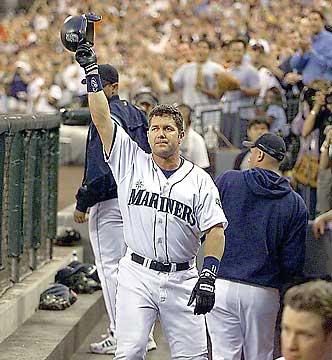
Unquestionably the best regular season team of the decade, but because they faltered against the Yankees, I can't give them the top team of the decade award. Except for the 1906 Cubs, no other team has ever won 116 games in a season. Ichiro-mania had taken Major League Baseball by storm. Bret Boone had a career year at the bat, and veterans like John Olerud and Edgar Martinez were part of an offense that had virtually no holes (save for left field, where former Pirate superstar Al Martin played a solid chunk of the season). A youthful (38) Jamie Moyer won 20 games, and Freddy Garcia and rookie Joel Pineiro had fantastic years on the bump.

1. 2007 Boston Red Sox 96-66, Won WS, #4 Pyth, #5 SD Score
No miracles from these guys, just domination. They abruptly ended Colorado's magical run to the World Series in 4 games. The offense wasn't quite as dominant as '04; David Ortiz was his usual tremendous self, but Ramirez had something of an off-year during the regular season. Lowell, Youkilis, and 2007 ROY Dustin Pedroia also provided some excellent hitting. The starting rotation was led by Cy Young runner-up Josh Beckett and also featured Schilling, Tim Wakefield, and Daisuke Matsuzaka. Closer Jonathan Papelbon was dominant. In the end, they did everything needed to win my world-famous title: they dominated on offense and on defense more than almost all teams in the past decade, and they won the big games when they mattered the most.

Near Misses: '08 Cubs, '09 Dodgers, '05 Cardinals

My extreme thanks to Baseball-Reference.com and Fangraphs.com for providing the stats necessary to make this happen.

Monday, January 4, 2010

First Semester Aftermath

If you don't know why his picture's leading off this post, Google him and find out. Then you may return for the rest of this post.

Before I begin, I wish for everyone reading this to have the best of years in 2010.

Although I’m only about a week away from starting back up with my spring semester classes, I just wanted to note my completion of my first semester of law school. It was a long, crazy ride, to say the least.

To those that say that law school changes the way you look at many things, I think you’re at least right in my case. My approach to watching programs on TV such as the legal issues of sports figures became a lot more critical, as I now have the knowledge to reason through what is most likely going on in their legal disputes.

Even in my everyday activities, legal principles arise in my brain rather quickly. The first time I drove my car after we finished discussing negligence in my Torts class, I made absolutely sure that I took all necessary precautions to ensure I wasn’t driving negligently should any accident occur. Yeah, I know, it sounds fairly paranoid. Blame law school.

Thankfully, despite not having anyone in my immediate family that attended law school, family gatherings weren’t dominated by discussion of what I was doing in law school.

I was pleasantly surprised that my section was filled with pretty good classmates. The classic description of one’s law school classroom is that there’s always "gunners", always willing to show off their knowledge of the subject and provide input, no matter how useless, to whatever discussion the professor has going at the moment. On the contrary, classes always seemed pretty civil and not dominated by a couple students. As always, I have to make a sports parallel; it was a team effort making it through our various classes this semester.

The law school curve does have me somewhat worried about grades (I should know what they are shortly after returning for spring semester). Thus, I tried not to carry on much discussion, if any, with classmates regarding how hard we thought the test was or how we answered particular questions. Really, any discussion seemed rather unproductive to me; the only person who truly knows and determines how well we did on the final exam is the person grading the exam: the professor. I’m hoping greatly that I can get a pleasant surprise soon from my grades. Good grades definitely would make me feel confident not that the big, high-paying firms will take a serious look at my resume, but that a wider range of good legal jobs will be more easily available to me.

I tried not to make this post too long; it’s merely to serve as my recognition, review, and basically celebration of completing my first semester of law school. Will it become more tolerable as the next semesters pass, as many say it does? I sure hope so...

Tuesday, December 15, 2009

Cy Young Predictor II: A Close One

Tim Lincecum and Zack Greinke. To say the least, these two pitched spectacularly throughout the season. At a minimum, they both put themselves in a position to possibly win a Cy Young Award, given to the best pitcher in each league, in 2009. The voters agreed, giving Lincecum his second straight award and Greinke his first. However, do the numbers truly support the voting tallies? Thankfully, there's a formula out there to help us figure that out. Starting last year, out of boredom I decided I wanted to calculate the winners for myself and compare them to the votes.

The formula was published in Rob Neyer and Bill James' The Neyer/James Guide to Pitchers as a way of determining not only who's the most deserving of winning the Cy Young Award for a league in a given year, but also who's most likely to be chosen by the voters as the winner. It incorporates a pitcher's wins, losses, saves, shutouts, strikeouts, runs saved (an equation based on the pitcher's ERA and innings pitched), and a 12-point victory bonus for "leading his team to a division championship." For my calculation, I also gave pitchers on wild card teams the victory bonus as well; wild card playoff teams are no worse off than the division winners when they reach the playoffs. Enough with the background; let's get to the formula's winners!

First, the American League...

Player W L K SV ERA INN POINTS
Hernandez 19 5 217 0 2.49 238.7 189.68
Greinke 16 8 242 0 2.16 229.3 175.57
Sabathia 19 8 197 0 3.37 230 169.19
Nathan 2 2 89 47 2.10 68.7 167.06
Rivera 3 3 72 44 1.76 66.3 163.85
Halladay 17 10 208 0 2.79 239 162.11
Verlander 19 9 269 0 3.45 240 160.75

A very legitimate argument could be made for Seattle's Felix Hernandez. King Felix shared the league lead in wins while on an 85-77 team. He pitched primarily in the AL West, against opponents who were 2nd, 7th, and 9th in the AL in runs scored. Greinke, on the other hand, pitched mostly against the 4th, 10th, 12th, and 13th best run scoring teams in the AL (out of 14 teams). Greinke finished 16-8 on a Royals team that was a full 20 games worse than the Mariners. Even though he played on the worst scoring team in the AL, Hernandez actually received nearly a full run of run support more than Greinke (5.66 to 4.83). As you can see from the table, Greinke leads Hernandez in many of the more well-known statistics, including shutouts, which I didn't include in my small table. Therefore, I tend to agree with all but 3 of the voters who voted for Greinke. 1 pitcher certainly does not make a team, so Greinke should not be harmed in voters' eyes by "only" winning 16 games while receiving far less run support than many other star pitchers in the AL.
Detroit workhorse Justin Verlander, perhaps boosted by the one voter who gave him a first place vote, finished 3rd in the actual voting; he was 7th here. Had Detroit won the one-game playoff against Minnesota at the end of the season, he would have finished 3rd in my predictor's standings.

Now let's move to the National League...

Player W L K SV ERA INN POINTS
Wainwright 19 8 212 0 2.63 233 189.11
Carpenter 17 4 144 0 2.24 192.7 178.04
Broxton 7 2 114 36 2.61 76 169.72
Lincecum 15 7 261 0 2.48 225.3 162.94
Bell 6 4 79 42 2.71 69.7 157.29
Franklin 4 3 44 38 1.92 61 149.56
Vazquez 15 10 238 0 2.87 219.3 141.69

Wow, the actual winner finished 4th by 26-and-change points. Granted, without the division winner bonus, Lincecum would have leapfrogged Carpenter and Broxton to finish 2nd. Looking at Wainwright (who actually received the most 1st place votes) vs. Lincecum feels very similar to my previous discussion of Hernandez vs. Greinke, except the situation is further compounded with the addition of Chris Carpenter to the discussion. Cardinal teammates Wainwright and Carpenter were backed by the NL's 7th best run-scoring offense, while Lincecum's Giants were only 13th. Carpenter and Lincecum actually received nearly identical run support, respectively 5.84 & 5.83 runs per outing, while Wainwright's support was at 7.07. The statistics I listed above note some differences that could give each pitcher's supporters a valid argument for the Award. Wainwright was both extremely effective and the best innings-eater in the league, but definitely received help from his Cardinal teammates in the win column. Carpenter had the same help, but his ERA was superior to his competitors; did the fact that he was hurt and missed some starts also hurt his chances of winning? Lincecum was a beast on the mound, dominating opponents and did not receive the same help from his weaker Giant offense, but should the Giants' lack of a division title be counted against him? It's not too hard to see why the difference in vote points among the 3 of them was a mere 10, and I think for the reasons listed above (and others) Tim Lincecum was a highly justifiable choice for the award. No gripes here.

And that's a wrap on the Predictor for this year. Let the discussion begin, or continue. Sorry I failed to publish this sooner; blame the crazy rigor and stress that surrounds 1L fall semester final exams primarily. Although you can also probably blame my usual slacker laziness as well...

I have some great ideas for posts in the very near future, so I hope you stick around my site at least for a little while longer! Catch you all (haha, baseball pun) later!

*statistics were either implemented or calculated using those provided on Baseball-Reference.com, except for run support which came from ESPN.com.

Thursday, November 19, 2009

Coming Soon...

Now that both leagues have decided their Cy Young Award winners, I will shortly post my version of the Cy Young Predictor. This year's award, according to the formula, was much more hotly contested than last year. As a sneak preview, I'll tell you now that unlike last year, where there were two much more clear-cut winners in both the voter's eyes and the formula's determination, neither of the formula's winners won this year...

The law school portion of my life seems to be moving along smoothly right now. The one graded exam I have taken went very well. With memos and such out of the way, I'll be focusing on wrapping up my classes, outlining for the imminent doom also known as 1L finals, and taking said finals. If only laziness were actually an option for a while before needing to study for finals...

That about wraps up my happenings for now. I'll make sure to get my big Cy Young post up ASAP. The Irish were robbed. Nice catch, Henry.

Wednesday, October 28, 2009

Why It's Possible to Do the Unthinkable

Just minutes from now, the 2009 version of the World Series will be underway in the Bronx. The series features two of the larger-market teams in baseball, the New York Yankees and Philadelphia Phillies. A great deal of non-Phillies/non-Yankees fans I know with any slight interest in the Series have been going through the following thought process in deciding who they want to root for:

"I don't really want the Phillies to go back-to-back, and I don't like their fanbase, but I REALLY hate the Yankees. So, I guess I'll cheer for the Phillies."


Like these people, I am interested in checking out this World Series, but neither team is the one I root for full-time. However, I'm finding myself much less inclined than others to hate the Yankees going into this World Series, the 40th in which the Yanks are appearing. On that note, as a non-Yankee fan, I'm going to shock the world by attempting to justify cheering for the Bronx Bombers. I've broken my arguments down into what I call the 3 P's...

1. Payroll
As a fan of a small-market team, why on earth would I want the team with a payroll many times larger than mine to win it all? For fans of these teams, it looks like with a payroll currently exceeding $200 million, the Yankees are trying to "buy championships." Well, if the team that's throwing the most money into team salary continually wins the World Series, then perhaps in the near future, there will be a higher possibility of more attempts to level the playing field among the 30 MLB teams. If a team that is being resourceful with a low payroll can't win the World Series, then the one who splurges on re-signing players, making trades and signing for marquee players deserves the championship. It's painful to cheer for a team that is harming the equality of the teams in the league, but with them winning more and more, more calls for change could be on the horizon.

2. "Parity"
If my team can't win in back-to-back seasons, then I don't want anyone's team to repeat. Believe it or not, the Yankees haven't won a World Series since the unfortunately over-hyped 2000 Subway Series with the Mets. Thus, if you're a strict fan of parity in professional sports, you probably want the Yankees to take this one, despite this being possibly their 27th World Championship. Also, if the Yankees win, perhaps they can officially regain their famous swagger throughout the organization and fanbase that they've held for decades. With that swagger that everyone loves/hates, maybe baseball can grow again. Or at least other baseball fans can be even more justified in hating the Yankees.

3. Power Players
Mark Teixeira, Alex Rodriguez, and Hideki Matsui are just a few of the names on the Yankee roster without rings to their name. I don't expect you to love all of them (I wonder which one of those three is liked the least...), but I at least find their style of play to be very exciting on most nights. Seven of their starters hit at least 20 home runs this year (Derek Jeter also had 18). The Phillies certainly have a great deal of bats that can match up with the Yankees, but if you love the offensive slugfests in baseball, no one scored more runs in Major League Baseball this season than the Bronx Bombers.
If you want to define "power players" even more broadly, you could throw in the many power arms included in the Yankee pitching staff. CC Sabathia, A.J. Burnett, Mariano Rivera, and even young guys like Joba Chamberlain and Phil Hughes bring some serious heat from the mound.
Also, who can write about the Yankees and not include the Steinbrenners? As owners, their aggressive approach to winning and getting the pieces necessary to win games put this year's team in a great position to take home the trophy. I think a lot of non-Yankee fans, especially fans of small-market teams, would trade their owners for ones as dedicated personally and financially as the Steinbrenners have been over the years.

To tell you the truth, that was somewhat painful to write. However, it does make me feel a little better about being a neutral fan this time around. Hopefully, if you're in the same boat as I am, this at least eased your hatred of the Yanks a little bit. Enjoy the Series...

Tuesday, October 20, 2009

Assistance


Surprise! My first actual post here isn't going to be about something sports-related. I've just returned from the law building to finish typing this out.

A couple of years ago, while still attending the University of Delaware as an undergrad, a friend of a friend and his parents were touring the campus when they randomly ran into my friend and me. As a result, I ended up basically advertising the school to him and his parents through my take on what the environment was like at UD. The next fall, I found out that he indeed chose to go to Delaware, and I felt very pleased that I very likely had a substantial role in his decision.

With that being said, I invite anyone (and anyone who knows someone) who has questions about the University of Delaware, going to law school, and Pitt Law School to send your questions my way. I am more than willing to help you out with any concerns or points of interest you might have concerning each. I will give you one fair warning though: especially relating to Pitt Law, I might not have quite the requisite amount of experience to give you a solid opinion about it, but I'll do my best to explain what I know.

Essentially, I'm talking up my abilities to give a realistic perspective for others to use however they want. What I can tell you very quickly right now is that I certainly do not regret attending the University of Delaware. For the LSAT, you're probably not the kind of person who can just walk into the testing room and post a big-time score, so you'll have to take it from me and make sure you budget a decent amount of time to preparing for the different sections. I have no idea whether the approach I took in applying to various law schools would work for you as well, so if you're applying now, I can tell you what I did and what I'd probably do differently were I to do it again. As for law school, I'd be lying if I told you it's been easy so far, but the experience has been very rewarding intellectually and I've made friends very easily with many of my classmates. I'm thankful that my law school hasn't (at least not yet) served to be a cutthroat environment with professors willing to make class time extremely rough on students. Again, as for anything else you would like to know, feel free to let me know.

I think that about covers the basics regarding my invitation to give advice to those who seek it. Whether you use it or not, I wish the best to everyone who at least took the time to read this. Expect my first sports post to come just after the World Series ends; I have an interesting project of sorts planned...